Living Planet Index


The Living Planet Index
The Living Planet Index (LPI) is a measure of the state of global biological diversity based on population trends of vertebrate species from around the world. It does this in much the same way that a stock market index tracks the value of a set of shares or a retail price index tracks the cost of a basket of consumer goods.
The Living Planet Database (LPD) currently holds time-series data for almost 43,682 populations of 5,891 mammal, bird, fish, reptile and amphibian species from around the world, which are gathered from a variety of sources such as journals, online databases and government reports. Using a method developed by ZSL and WWF, these species population trends are aggregated to produce indices of the state of biodiversity. The rest of our work focusses on expanding the coverage of LPI data to more broadly represent vertebrate biodiversity from all around the globe and disaggregating the index to measure trends in different thematic areas. This includes assessing the changes in different taxonomic groups, looking at species trends at a national or regional level, identifying how different threats affect populations and providing an insight into how conservation intervention can promote species recoveries.
The global trend
The global LPI as presented in the Living Planet Report 2026 shows that a subset of 35,803 populations of 5,790 species has declined by an average 73% in abundance between 1970 and 2022. The Living Planet Report 2026 results indicate that species are faring much worse in freshwater systems and in tropical regions. Freshwater populations declined by an average of 85%, while IPBES regions declined by between 28% and 95%, with Latin America & Caribbean and Africa showing the steepest declines (95% and 80%, respectively).
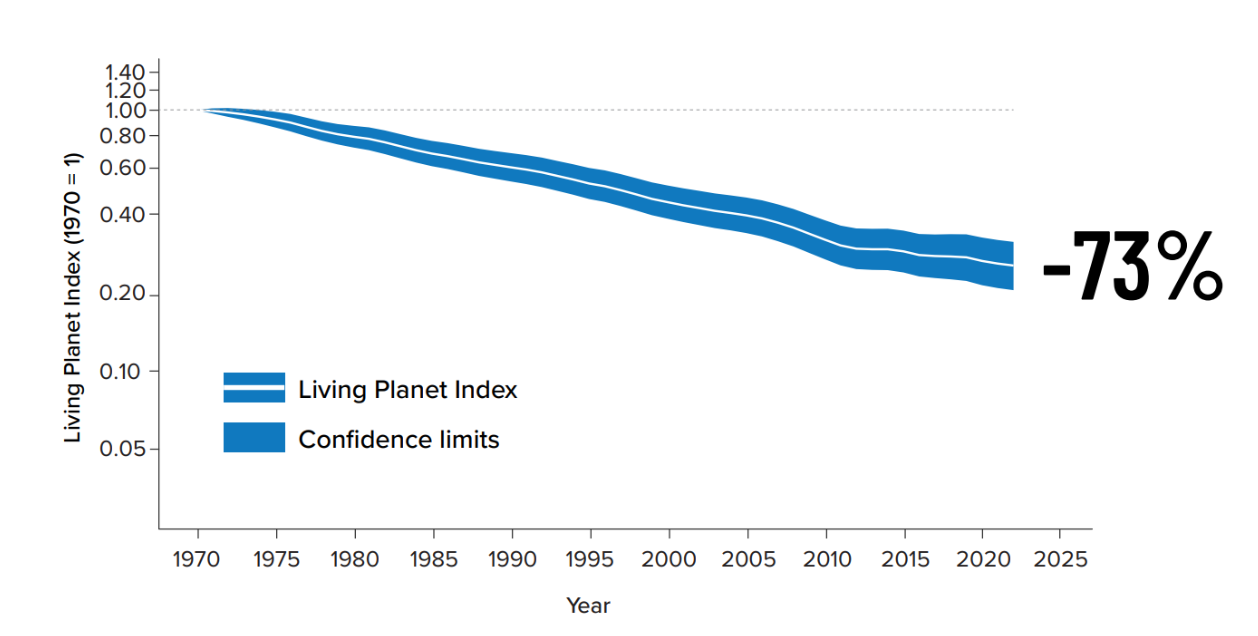
The global LPI shows a 73% average decline between 1970 and 2022. The white line shows the index values and the shaded areas represent the 95% confidence limits surrounding the trend (WWF/ZSL 2026).